Every agency now calls itself AI-powered. That phrase means nothing until the agency connects its technology to a cost your finance team can audit.
AI can reduce cost per acquisition through less wasted spend, faster tests, and lower production costs. Your budget case must show the baseline, conversion definition, comparison period, and measurement method. Use those facts when building the full CFO budget case.
Key takeaways
- AI has value when a named system completes a specific job on your account.
- Platform tools such as Google Smart Bidding and Meta Advantage+ are available to every qualified agency. Access alone is not a differentiator.
- AI can lower CAC through waste reduction, faster test cycles, and lower production costs.
- An improvement without a stated baseline is not a result. It is an unauditable claim.
- Ask for workflow records, quality assurance logs, human review steps, and unit economics.
- Test an agency during a live work session before you accept its claims.
What does AI-powered actually mean for my campaigns?
AI-powered means that a named system completes a defined campaign task. The agency must show the input, output, human review, and business metric. If it cannot name the task, there is no useful claim to evaluate.
In a real marketing program, AI usually performs six jobs:
- Automated bidding: The system changes bids from auction signals and defined conversion goals. The artifact is the bid strategy configuration.
- Audience and propensity modeling: The system scores people or accounts against observed behavior. The artifact is a propensity score or audience segment.
- Creative testing: The system produces or evaluates variants. The artifact is a version set with test results.
- Research and analysis: The system organizes source material and identifies patterns. The artifact is a cited research brief.
- Quality assurance: The system checks content, campaigns, links, tracking, or data. The artifact is a quality assurance log.
- Reporting: The system collects data and flags changes. The artifact is a reporting pipeline with source access.
Translate each job into finance language. Automated bidding can reduce wasted spend. Creative testing can increase tests per dollar. Research and quality assurance can reduce production hours per approved asset.
Google defines Smart Bidding as auction-time bidding that uses Google AI to optimize for conversions or conversion value. Performance Max uses the same platform across Google inventory. Meta Advantage+ also uses platform automation for campaign work.
These systems can have value, but every agency receives access through the same ad platforms. Platform-native AI is not proprietary agency technology.
An agency creates additional value when it builds a repeatable process around those systems. The process must include clean data, account controls, review rules, and clear ownership. Read what actually differs between an AI agency and a traditional one.
Access to a large language model is also not a method. A paid model seat does not prove strategy, quality, or economic value. Review how AI agencies price their work before you pay a premium.
AI does not define your ideal customer profile or repair a weak offer. It does not judge brand fit without human direction. It also cannot own the client relationship.
How does AI-powered marketing actually lower cost per acquisition?
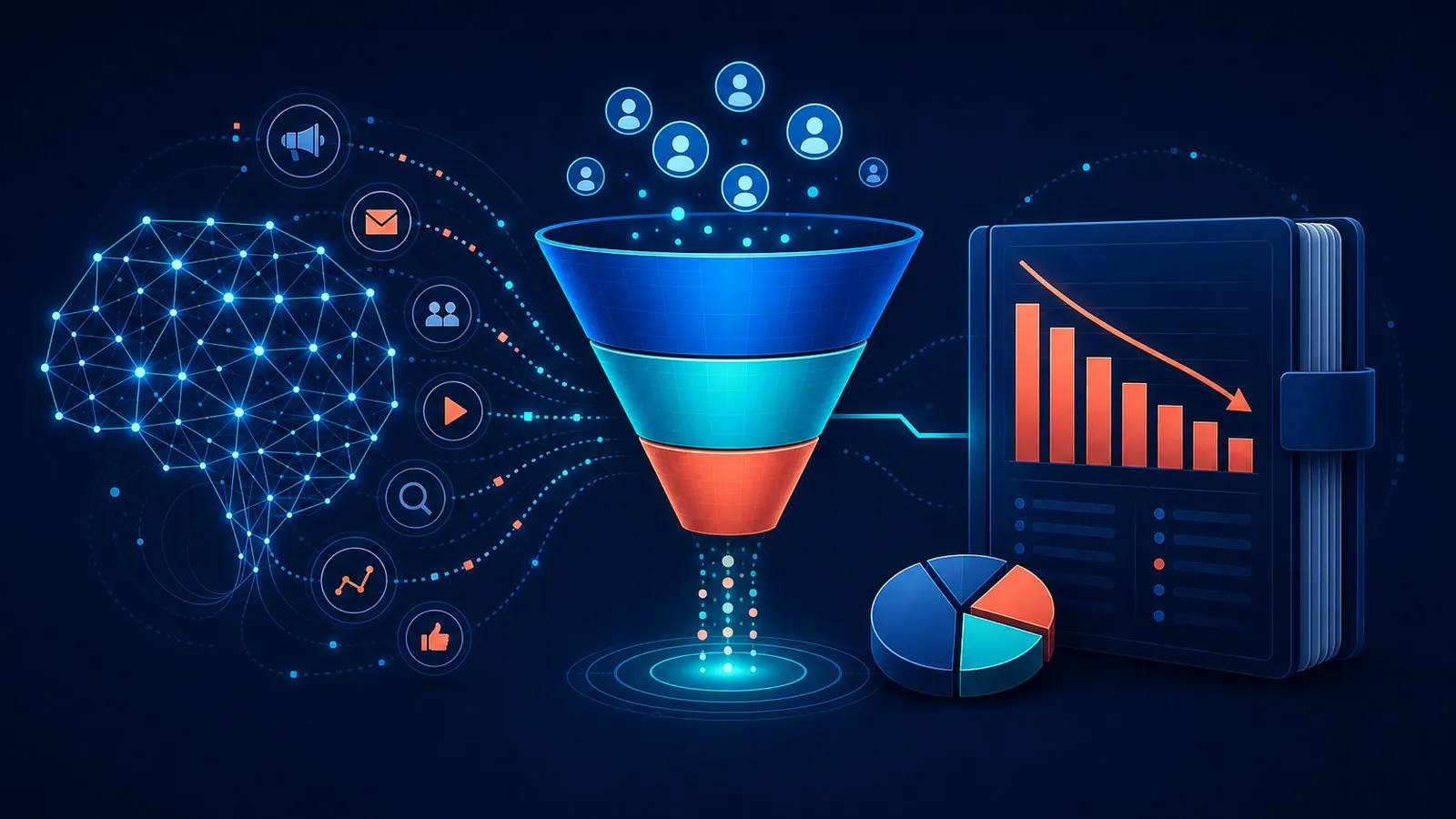
AI can lower CAC through three auditable mechanisms. It can reduce wasted media spend, increase useful tests per dollar, and decrease production cost per approved asset. Each mechanism must connect to a finance line.
Use this basic formula:
Cost per acquisition = total acquisition cost divided by new customers.
Total acquisition cost includes media, agency fees, production costs, technology, and relevant internal labor. Paid CAC includes paid acquisition costs. Blended CAC includes all measured acquisition costs across paid and organic channels.
Keep the definitions stable across periods. If one quarter counts booked demos and another counts form fills, the comparison is invalid. Use the metrics a CFO will actually accept to define the scorecard.
1. Less wasted spend
Signal-based systems can change bids for device, location, time, audience history, and other factors. Google documents these signals in its Smart Bidding guidance.
Automation still needs human constraints. A system can optimize toward low-quality conversions when the account sends weak conversion data. The cost per lead can decrease while the cost per qualified lead rises.
2. More tests per dollar
AI can produce more message and creative variants within the same production budget. More output alone has no economic value. The team must stop weak variants and move budget toward verified winners.
Measure test velocity with tests per quarter, time to a useful signal, and cost per completed test. Faster learning reduces the cost of a wrong campaign hypothesis.
3. Lower production cost per approved asset
AI can reduce manual time for research, first drafts, variant creation, data checks, and report preparation. Humans still set the position, check evidence, and approve the final work.
This change matters for SEO and Answer Engine Optimization because the production process includes research, editing, links, technical checks, and publication. Count approved assets, not generated drafts.
The 2025 Benchmarkit report found a median new-customer CAC ratio of $2 in sales and marketing expense for each $1 of new customer annual recurring revenue in its 2024 data. The report also states that annual contract value affects CAC comparisons. Use a benchmark as context, not as your company target.
| Metric | Baseline quarter | AI-assisted quarter |
|---|---|---|
| Media spend | $100,000 | $96,000 |
| Agency and production cost | $50,000 | $44,000 |
| Total acquisition cost | $150,000 | $140,000 |
| Qualified leads | 500 | 600 |
| Cost per qualified lead | $200 | $160 |
| New customers | 25 | 28 |
| Blended CAC | $6,000 | $5,000 |
| Production hours | 600 | 360 |
This example is illustrative. It is not a Volado Labs result or a performance promise.
Put your actual numbers into the same table. Keep the channels, attribution model, customer definition, and period length constant.
AI cannot fix poor pricing, weak positioning, or an unqualified market. If one of those factors limits growth, faster campaign work will not repair CAC.
How do I test whether an agency’s AI claims are real?
Run three tests before you sign. Require a live work session, inspect process artifacts, and ask about a recent failure. Real operators can show their work without hiding behind a sales presentation.
Run a live work session
Give the agency a real campaign question and a safe sample of your data. Ask the team to share its screen and complete part of its process.
Watch how much correction the output needs. Ask who makes those corrections and how the team records them. The agency must identify errors without pressure from you.
Request the artifacts
Ask for the tool inventory, workflow record, prompt or configuration history, quality assurance log, and human approval step. Check whether the records existed before your request for proposal.
Do not accept “proprietary” as a reason to hide the complete method. An agency can protect confidential details while it proves that the process exists.
Ask about failure
Ask this question: “What did your AI get wrong last quarter, and what did you change?”
A credible team can name a failed output, its cause, and the new control. A team with no failure record probably does not inspect its systems closely.
The FTC announced Operation AI Comply on September 25, 2024. The enforcement actions addressed deceptive AI claims and AI-enabled conduct. Treat unsupported agency claims as a diligence risk, not harmless sales language.
Reference checks must focus on cost and cycle time. Ask former clients what changed, how they measured it, and who performed the strategic work.
These tests are useful when you are rebuilding the case after a failed engagement. One direct work session can reveal more than a long pitch deck.
How do I tell AI-assisted work from generic AI-generated content?
AI-assisted work contains evidence that reflects the client. Look for original data, dated sources, customer language, product mechanics, and a clear position. Generic output stays fluent but says little that another company could not use.
Apply the swap test. Place three client deliverables beside each other. Remove the company names and ask whether each document still belongs to one specific client.
Look for these signs of useful AI-assisted work:
- Claims link to dated, authoritative sources.
- Numbers include definitions and a measurement method.
- The copy names real customer objections and product mechanics.
- Section lengths follow the subject instead of a fixed pattern.
- A human takes a clear position and accepts responsibility for it.
Warning signs include padded definitions, equal section lengths, unsourced claims, weak conclusions, and no product detail. High volume does not correct those defects.
Google defines scaled content abuse as large amounts of unoriginal content created mainly to manipulate rankings. Its policy covers low-value pages regardless of how they were created.
Good production assigns research synthesis, outlines, variants, and mechanical checks to AI. People provide judgment, customer knowledge, source approval, and final accountability.
What proof must an agency provide for its AI method?
Ask for four artifacts before you accept an AI claim. Require a tool inventory, a workflow with named human review, before-and-after unit economics, and a case study with a baseline period.
| Artifact | What it proves | What a weak version looks like |
|---|---|---|
| Tool and model inventory | Shows the job, system, input, and output | A logo list with no account task |
| Documented workflow | Shows review points, owners, and controls | A diagram with no named owner |
| Unit economics | Connects the process to cost, volume, and quality | Output counts without approved assets or revenue |
| Baseline case study | Shows the comparison period and conversion definition | A percentage with no starting value |
| Quality assurance log | Shows errors, corrections, and recurring controls | A promise that a human reviews everything |
Demand the conversion definition, attribution model, pre-period length, exclusions, and data source. Ask whether the comparison uses the same channel, audience, offer, and sales process.
For paid media, use incrementality testing when the account and budget permit it. Google describes Conversion Lift as a method that measures the causal effect of ads on conversions.
An improvement without a stated baseline is not a result. It is a sentence.
The contract must name the reporting cadence, human owners, account access, and source-data access. You need the evidence even after the agency relationship ends.
The Volado Labs services page describes AI-assisted content, SEO, paid growth, and strategic advisory services. Ask Volado Labs or any agency to connect each proposed process to a specific artifact and cost line.
What questions cut through AI marketing buzzwords?
Nine questions force specific and checkable answers. Copy them into the evaluation call and score the evidence. Give the scored record to your CFO with the cost model.
- Which specific task does AI perform in this engagement?
- Which tool or model performs it, and is the system platform-native or yours?
- Who reviews the output before release? Give the person’s name and role.
- Can you show the same deliverable for two different clients?
- What was the pre-period baseline in your case study?
- How do you define a qualified conversion?
- What did your AI get wrong last quarter?
- What work do you refuse to automate?
- What happens to my CAC when you remove this system?
A good answer to question one names a task, input, output, and metric. A weak answer names a broad service.
A good answer to question five includes dates, costs, conversion definitions, and exclusions. A weak answer gives only a percentage.
A good answer to question seven describes an error and a new control. A weak answer claims that the system has not failed.
Use these questions with the broader agency evaluation questions. The final decision must rest on evidence, not enthusiasm.
What numbers belong in the finance deck?
Show the mechanism, baseline, test design, and observed change. Keep vendor claims outside the forecast until your data confirms them.
Your finance slide needs these fields:
- Total acquisition cost by channel
- Paid CAC and blended CAC
- Cost per qualified lead
- Qualified lead and customer definitions
- Customer acquisition cost payback period
- Production hours and cost per approved asset
- Tests per quarter and time to a useful signal
- Attribution model and pre-period baseline
Separate observed results from forecasts. Label every forecast assumption. Do not apply a vendor’s best case to your full budget.
The decision rule is simple. AI earns a budget line when it changes a measurable cost mechanism and survives direct verification.
Bring finance the mechanism, baseline, and test record. Do not bring vendor adjectives. For help building the full CFO budget case, connect these numbers to cash timing, risk, and ownership.
If you want to test the process before a larger commitment, book a working session on your live data with Volado Labs. Ask to see the work, not the pitch.
Sources
- Google Ads Help, About Smart Bidding
- Google Ads Help, About Performance Max Campaigns
- Meta for Business, Meta Advantage+
- Benchmarkit, 2025 B2B SaaS Performance Metrics Benchmarks
- Federal Trade Commission, Operation AI Comply, September 25, 2024
- Google Search Central, Scaled Content Abuse Policy
- Google Ads Help, About Conversion Lift
FAQ
Does AI actually reduce CAC?
AI can reduce CAC when it cuts wasted spend, increases useful test velocity, or lowers production cost. Measure the change against a stable baseline.
What is the difference between paid CAC and blended CAC?
Paid CAC uses costs from paid acquisition channels. Blended CAC includes all measured acquisition costs across paid, organic, agency, production, and relevant internal work.
Is AI-generated content bad for SEO?
AI use alone does not make content harmful. Google targets scaled, unoriginal content that adds little value and exists mainly to manipulate rankings.
What must an AI agency show me before I sign?
Require a tool inventory, documented workflow, named human reviewers, quality assurance records, baseline case studies, and clear conversion definitions.
How can a CFO verify an AI-attributed CAC improvement?
Compare equal periods with the same conversion definition, channel scope, attribution model, and cost categories. Then test whether another factor caused the change.
Ready to grow faster with AI-powered marketing? Schedule a Free Strategy Call